10/25/2019 ALNA Part 3: Variability

To recap, Allena has made some pretty big changes to their Phase 3 design, compared to previous trials. Urirox-1 is being tested in enteric hyperoxaluria patients only, have increased the dose to match the patient’s eating habits, are using a Time Weighted Average to measure UOx reduction, and are raising the baseline UOx levels to above 50 mg/day. Is this enough to reduce the large variability we have seen in the past?

Cons
Contribution of diet: What’s clear is that diet affects UOx levels. What’s not clear is by how much. Some studies state the contribution is 10-20% (Williams 1989), while others show up to 41.5% (Holmes 2001). Calcium content and hydration status can also lower UOx levels.

Is 20% enough?: Mouse studies of OxDc-CLEC only showed an increased survival at 40% reduction of UOx. There was not a clear dose response at doses below that level, though all doses lowered UOx. Is the 20% bar ALNA is aiming for enough to show lowering of kidney stone formation? This will be answered in the second Phase 3 trial, Urirox-2.

Why the 50 mg/day cutoff?: While the higher baseline patients historically respond better, why did ALNA choose 50 mg/day as the cutoff? The company has stated they consider that a “severe” population, yet their average baseline is 103 mg/day (making that super severe?). I can not find any clear clinical reasoning behind 50 mg/day cutoff, aside from ALNA noticing Reloxaliase has a better effect above these levels.

Oxazyme no longer being pursued: Oxazyme (OC4) is a similar enzyme to Reloxaliase. However, the compound is no longer being pursued in favor of a bacteria therapeutic. More on Oxazyme below.

How high are EH UOx levels actually?: Per the company, 44.4% of enteric population had at least 1 normal UOx value <45 mg/day over 22.5 months, although overall UOx was higher. About 40% of idiopathic patients also approached absorption levels of enteric patients, but Reloxaliase had a dramatically worse effect in IH.

Effect of the microbiome?: Several reports have shown that Oxalobacter formigenes can degrade oxalate. Consistent with other microbiome trials, studies of O. formigenes have been…inconsistent. However, there is some evidence that hyperoxaluria patients have lower levels of O. formigenes (Nazzal 2015).

Potential placebo response?: A few placebo enteric patients at high UOx baseline have shown drastic lowering of UOx. The company expects no placebo response, overall.


Variable measurements: It was found that peak UOx occurs 2-4 hours after oxalate intake. Clearly, the timing of capturing UOx levels makes a difference. Using a time weighted average will seek to address this.

Suboptimal pH: OxDc has optimal activity in acidic pHs, but down to about 2-7% residual activity at neutral pHs (Conter 2019).

What happened in Study 649?: Recall, this crossover trial of two 7-day treatment periods was stopped early due to no difference w/placebo. However, other trials as short as 4 days showed an effect on UOx. Is this due to inconsistency in drug efficacy, or an issue with the crossover design, which theoretically reduces inter-patient variability, but not intra-patient.

Pros
Time Weighted Average: TWA is defined as the average of all 24 hour UOx excretion values while obtained on drug, with each value weighted for the number of days since the last urine collection. In theory, this would lower variability in UOx by accounting for differences in hydration status, inherent variability with the assay, dietary changes, and sample handling.

Cutoff is more stringent than meets the eye: A previous Phase 2 study had a 50 mg/day UOx cutoff. However, in that trial, the patients only needed to have a > 50 mg/day reading at screen-in. In Urirox-1, patients must have both a >50 mg/day at screen-in and two baseline measurements above 50 mg/day. This should add some consistency to the results

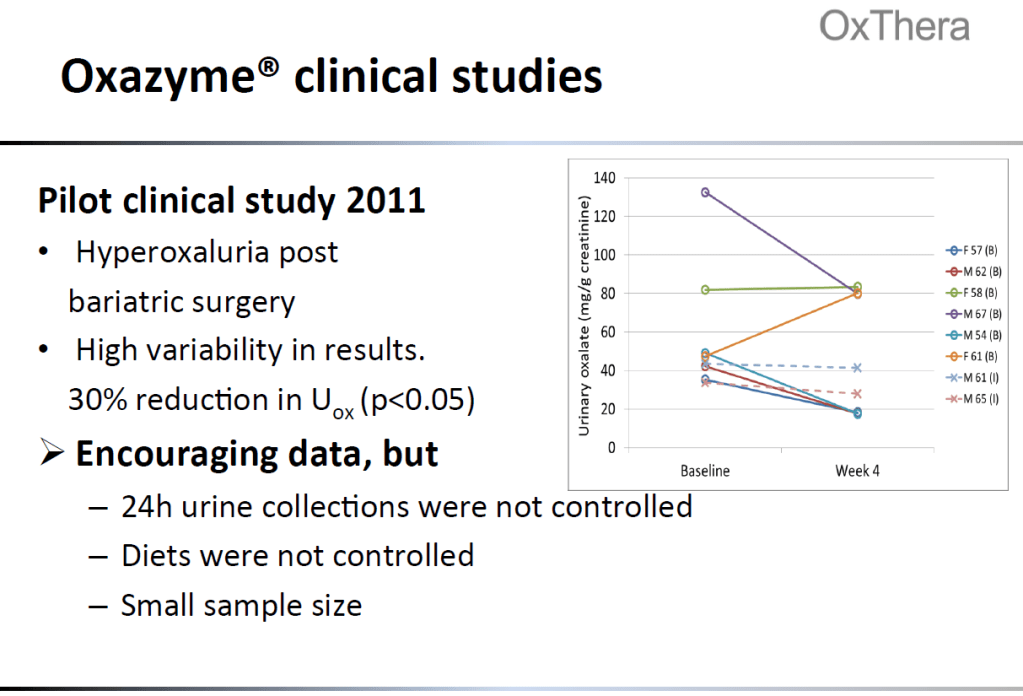
Proof of concept?: Oxazyme has shown some efficacy in a small trial. Data from the Oxazyme trial is below. Nephure is also an enzyme dietary supplement designed to lower oxalate (and has multiple 5 star reviews on Amazon! Some customers have lab tests showing efficacy. “Stephen” left a useless 3 star review saying he doesn’t know if it works yet. Why leave a review then!?!)

-UOx is an accepted endpoint: The FDA has agreed that UOx lowering is an acceptable surrogate endpoint for kidney stone progression (ALNA will look to confirm this in Urirox-2). Of note, time weighted averages have also been used historically (ex. Tenofovir)

EH and higher UOx: Though the UOx is variable among enteric patients, with some reporting occasional normal values, the overall population has a higher UOx level than other secondary hyperoxaluria patients. This would be the population to show the most benefit, if Reloxaliase works as intended.

Misc.
-Oxazyme is similar to Reloxaliase, but with one amino acid swapped to prevent aggregation. It was tried in an enteric population (post-bariatric surgery), but also showed high variability in UOx reduction, though the overall reduction was by 30%. Oxazyme has been tabled in favor of an Oxalobacter formigenes product.

-Nephure is being marketed as a dietary supplement to lower oxalate levels. Like Reloxaliase, Nephure is a powder form to be taken with meals. A white paper published by the company showed an average reduction of 13 mg/day in normal patients on high oxalate diets. However, normal patients and hyperoxaluria patients respond different to oxalate intake. Now marketed, some anecdotes with lab results from customers show some lowering of UOx.

-Cash levels will be ~$40m at the end of 3Q19, equating to $1.70/sh

10/24/2019 ALNA Part 2: Learning by Failing

Allena’s upcoming Phase 3 trial, Urirox-1, is being tested in a specific population called enteric hyperoxaluria. However, this wasn’t always the case, and the company has tried several smaller trials in a larger population with mixed results. Hyperoxaluria can be classified as primary (due to overproduction of oxalate by the liver) or secondary (over absorption from the diet). Secondary hyperoxaluria can be further divided into enteric (resulting from a chronic GI disorder from bariatric surgery complications, or diseases like Crohn’s) or idiopathic (unknown cause). Enteric is thought to be the more severe population compared to idiopathic. Because reloxaliase is intended to degrade oxalate consumed in the patient’s diet, it would, in theory, be more likely to work in secondary hyperoxaluria. Since 2012, Allena has run a few Phase 2 trials in secondary hyperoxaluria, attempting to demonstrate a lowering of urinary oxalate (UOx) levels from baseline.

Study 716
-67 patients with secondary hyperoxaluria with at least 50 mg/24 UOx
-4 week trial
-7500 units, 3x per day
Primary endpoint: LS mean reduction Reloxaliase: -6.35 mg/day vs placebo: -2.40 mg/day (NS, p=.16)
Secondary: Time Weighted Average reduction: Reloxaliase: -9.08 mg/day vs placebo -0.96 mg/day (p=.016)

Study 396
-16 secondary hyperoxaluria patients, open-label, single arm
-7500 units, 3x per day
-4 day trial
Average UOx reduction of -13.92 mg/day
-11/16 (69%) had “some” reduction in UOx, mean was -23%

Study 649
-30 secondary hyperoxaluria patients, crossover design
-Two 7 day treatment periods separated by 7 day washout
-1500, 3000, or 7500 units, 3x per day
-Trial halted after 12 subjects in low and mid dose groups
-After 24 subjects, there was an inability to differentiate between treatment arms
-Post-hoc evaluation showed no clear factors that influenced inability of reloxaliase to show an effect

Study 206 (ongoing)
-Primary or enteric hyperoxaluria with advanced kidney disease, > 40 mg/day UOx
-12 week, open-label treatment
-7500 units, up to 5x per day
-Interim data showed two enteric patients with -29% and -42% reduction in UOx
-One primary hyperoxaluria patient responded with >-20% mg/day reduction, other 2 did not respond

Study 183
-Phase 1 study, 33 healthy adults; fed high oxalate diet
-7500 units, 3x per day
-7 day trial
-UOx went from 27.2 mg/day -> 80.8 mg/day on the high oxalate diet
-Reloxaliase reduced UOx excretion by -11.54 mg/day
-Mean reduction of 18/30 responders (60%) was -20 mg/day

Lessons learned from Phase 2 trials
-Reloxaliase has better efficacy in the enteric hyperoxaluria population
-Time Weighted Average may lower intra-individual variability in UOx by taking into account diet, metabolic activity, hydration status
-Subjects with enteric hyperoxaluria end up having more than 3 meals per day and more than 2 snacks per day, meaning 28% of total daily oxalate is from snacking
-Higher baseline UOx tended to show greater reduction in UOx
-Enteric patients have a higher baseline UOx than idiopathic (103 vs 57 mg/day)

Urirox-1 Phase 3 trial
Importantly, ALNA took these lessons and made some adjustments to the inclusion/exclusion criteria and endpoints that give them a better chance at success. First, the Phase 3 trial is only in enteric hyperoxaluria, a patient population in which ALNA has seen greater success. Next, the dosing has been increased to up to 5x per day, to account for oxalate intake outside of meals. The baseline cutoff for UOx has also been increased to >50 mg/day, levels where ALNA has seen better efficacy. Finally, the primary endpoint is a time weight average of UOx reduction after 4 weeks. Excitingly, the FDA has agreed that positive data from Urirox-1 and the second Phase 3 study (Urirox-2) could form the basis for accelerated approval, with UOx reduction as a surrogate endpoint. So what do the previous studies look like if some of the Phase 3 adjustments are accounted for? In Urirox-1, ALNA is trying to demonstrate at least a -20% reduction in UOx levels from baseline.

It’s important to note that a lot of these adjustments were based on a post-hoc analysis. There are also numerous caveats, both positive and negative, that I’ll discuss in Part 3!

10/23/2019 Allena Part 1: A Convoluted History

To preface, Allena Pharmaceuticals (ALNA) has a Phase 3 readout coming in Oct/Nov 2019 for its lead product, Reloxaliase, in enteric hyperoxaluria. It’s a crystalline formulation of an enzyme, oxalate decarboxylase, designed to break down oxalate – a molecule that humans cannot break down, but absorb from foods we eat and endogenously produced mostly by the liver. Too much absorption or production can lead to calcium oxalate stones (kidney stones) and lead to end stage renal disease. But where did this drug and enzyme therapy idea come from?

The story begins with Alexey Margolin, the co-founder, and now the Chairman of the Board of ALNA. From 1993-2007, he was CSO at a company called Altus Therapeutics. Margolin was in charge of a product called liprotamase, which started development on in 2001 in collaboration with the Cystic Fibrosis Foundation (CFF). Also known as Trizytek (and later Sollpura), liprotamase was a porcine-free pancreatic enzyme therapy for cystic fibrosis patients with pancreatic insufficiency. The company finished several smaller trials, but ran into financial difficulties and discontinued development mid Phase 3 trial. The CFF then looked for another partner to finish the drug and hopefully bring it to market.

Just before this, Margolin had left Altus, and formed Alnara Pharmaceuticals in 2008 with a $20m Series A backed by Frazier Healthcare (James Topper), Third Rock (Robert Tepper), and Bessemer Ventures. Margolin saw the opportunity to work on liprotamase again, and licensed the rights from CFF in 2009. Alnara quickly went from a 1 person shop to hiring 20 people in the next 10 days. The Phase 3 trial finished, but liprotamase did not show as much efficacy as hoped. Still, Alnara raised another $35m in a Series B to submit the drug to the FDA. In 2010, Eli Lilly purchased Alnara (later revealed to be $180m upfront, up to $380m), rewarding early investors. However, not all went well for LLY, as the drug went on to be rejected by the FDA. Years later in 2014, Anthera would purchase the rights, run another Ph3, ultimately be rejected again in 2018, and would finally discontinue development of the drug.

Concurrently, Altus had shifted focus to its growth hormone formulation, finished a Phase 2 trial, but ran into the death spiral commonly seen in small biotechs. Running out of cash again, Altus was purchased by Althea Technologies in 2010 (Althea was then purchased by Ajinomoto for $175m in 2013). The early growth hormone data showed relevant PK/PD for once-weekly injections, but the company lacked any funding to move it to a larger trial (especially after Genentech pulled their collaboration). Along with the GH asset came Altus’s Cross Linked Enzyme Crystal (CLEC) IP. CLEC was intended to allow enzymes to remain active in otherwise incompatible environments, such as high temperatures, or extremes of pH. In 2009, Altus ran a preclinical trial of a CLEC formulation of oxalate decarboxylase (OxDc-CLEC) that showed lowering of urinary oxalate in animal models.

What became of Margolin after Alnara’s acquisition? He moved on to start two companies. One was Alcresta in 2012, also in the field of enzyme therapies, backed by Bessemer, Frazier, and Third Rock in a $10m Series A. Alcresta would form a collaboration with the CFF in 2013. The other was Allena in 2011, backed by Bessemer, Frazier Healthcare (James Topper), and Third Rock (Robert Tepper) with a $15m Series A. In 2012, Allena then licensed rights to the hyperoxaluria portfolio from none other than Althea Technologies (making this a lovely full circle). Of note, Reloxaliase seems to be a slightly different formulation. ALNA emphasizes that it is an uncrosslinked version of oxalate decarboxylase, which seems to have a higher activity in more acidic pHs, but perhaps is more susceptible to proteolytic degradation in the GI tract. To date, ALNA has run several smaller trials in hyperoxaluria. Does it work? Sort of, but more on that in Part 2.

If you’re confused with this history like I was, I drew you a crude diagram to illustrate how all this went down.